

"Not a content creator"
definition by negation, horizontal hostility, and a flattening world

I’ve got an itch I must scratch. In my previous newsletter I mentioned I studied philosophy at UCLA before dropping the major to graduate early. What drew me most to philosophy was meaning-making and how we come to define “things.” How do you know, for example, an apple is an apple? How do we create the symbols for these things? You can use different approaches: description - an apple is sweet, crisp, red and/or green; comparison - an apple is like a firm pear; negation - an apple is not like a mushy banana.
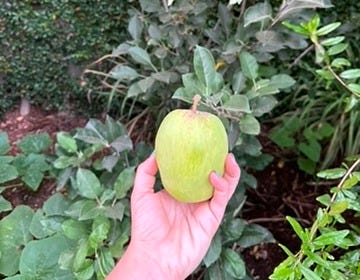
The study of how things come to mean is called semiotics. It is an integral part of human existence. I’ve dusted the cobwebs off this part of my education after a string of social media posts stopped me in my scroll. One pattern keeps showing up. Definition by negation.
Examples of definition by negation:
Professional positioning. Ali Slagle, recipe developer and author whose work I admire, posted a carousel delineating the differences between a recipe developer and a content creator. It’s not pure negation. She softens it with a “both” at the end, naming the shared ground. The positioning is still there. You hear the same move all over the food world: “she’s a home cook, not a chef.” I want to be clear: Slagle's work is impeccable, and her post is a thoughtful one. The fact that I keep returning to it is a compliment. It made me think.
Product positioning. The natural wine movement runs on definition by negation. Terms like zero-zero encode the negation in the name itself: this wine is not filled with additives, chemicals, or preservatives. The product is defined by what it lacks.
Identity positioning. I’m a farmer, not a homesteader. I’m a gardener, not a tradwife. This is the most personal version of the move. Telling you who I am by telling you who I’m not.
We are in a unique cultural moment where definition by negation has become the prevailing way to make meaning. Social media has flattened us. Everyone is adjacent to everyone else.
Optimal Distinctiveness Theory
In 1991, social psychologist Marilynn Brewer posited her optimal distinctiveness theory1. There is a human need to belong to something (a group, category, tribe). Yet, we also want to be distinct from those within our cohort. These two competing needs push and pull against one another. Our social identity emerges from the constant negotiation between belonging and being different at once. Belong, but not too much; stand out, but not so much you’re alone.
Brewer mapped this onto a spectrum (pictured below). At one end of the x axis, total uniqueness. These are features that distinguish you from someone else in a given context. At the other end of the x axis, total submersion: there is no differentiation between you and the group. We spend our lives somewhere in the middle, picking levels of distinction that feel right for the context.
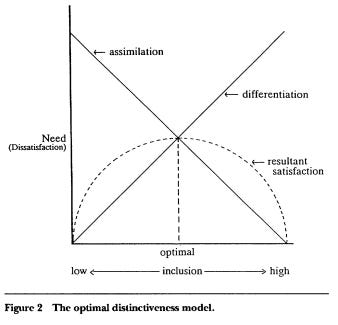
As Brewer puts it: “The higher the level of inclusiveness at which self-categorization is made, the more depersonalized the self-concept becomes” (Brewer 1991).
Here’s how this works for me. “I work with food” is a widely inclusive self-categorization. It’s true, but quite generic. To feel more like me, I might specify: I develop seasonal recipes. I grow my own food. I’m not a formally trained chef. Each move trades belonging for greater distinctiveness. Each move pushes me closer to uniqueness.
This brings me back to context. Brewer states that distinctiveness is context-specific. Where you’re performing the differentiation of your identity matters. Bringing it back to Slagle’s carousel post: she is defining her professional identity on Instagram, the same platform she’s distancing from. If she said the same thing at an author’s retreat, surrounded by other recipe developers, the act of distinguishing herself would resonate differently.
Horizontal Hostility
You see a similar pattern across the creator universe. A writer leaves Substack and keeps telling you about it. A creator swears off Instagram while posting daily on YouTube. The hostility gets directed at the platforms they’ve left or opted out of, more pointed than anything they’d say about say, a network television show. That’s because the chef on Food Network isn’t a threat. The newsletter right down the street is.
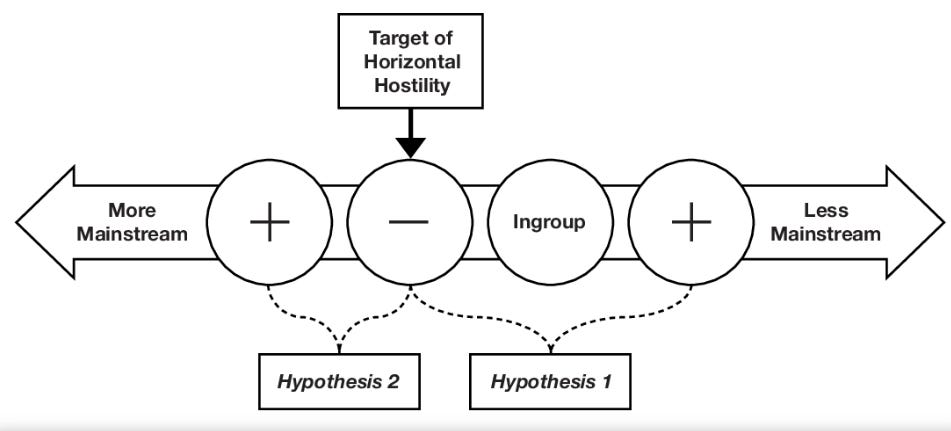
This pattern has a name. Horizontal hostility2 is the tendency for adjacent social groups to push away from each other more aggressively than distant ones. In 2006, psychologists Judith White, Michael Schmitt, and Ellen Langer published a study I think about a lot, “Horizontal Hostility: Multiple Minority Groups and Differentiation from the Mainstream.” Their finding through several experiments was simple. When a smaller group defines itself against a larger one, the hostility doesn’t go toward groups that are far away. It goes toward the group right next to it. The one that looks pretty similar from the outside. A relevant study was on vegans and vegetarians. You might think these two groups feel like allies (animal rights advocates, climate action, etc). But the study showed something interesting. Vegans expressed less positive attitudes toward vegetarians than vegetarians did toward vegans. The smaller, more committed group pushed harder against the larger, more mainstream group because the two are so close.
Map this onto Slagle’s Instagram carousel and the pattern clicks into place. In my interpretation of her framing, the recipe developer is the vegan and the content creator is the vegetarian. Recipe developers are more rigorous, more invested in distinction (á la optimal distinctiveness theory). The cruel irony: the flattening of the creator economy has forced recipe developers to use the tools of content creation to stay visible. The vegan has to eat at the vegetarian restaurant. The distinction is now rhetorical because it can no longer be structural.
Stereoscopic versus Monocular Vision
One of my favorite books from my philosophy studies is a comic. Unflattening3 by Nick Sousanis is a comic book that uses words and images to show that meaning-making is a never-ending process. We never arrive at understanding something in its totality. We move through it.
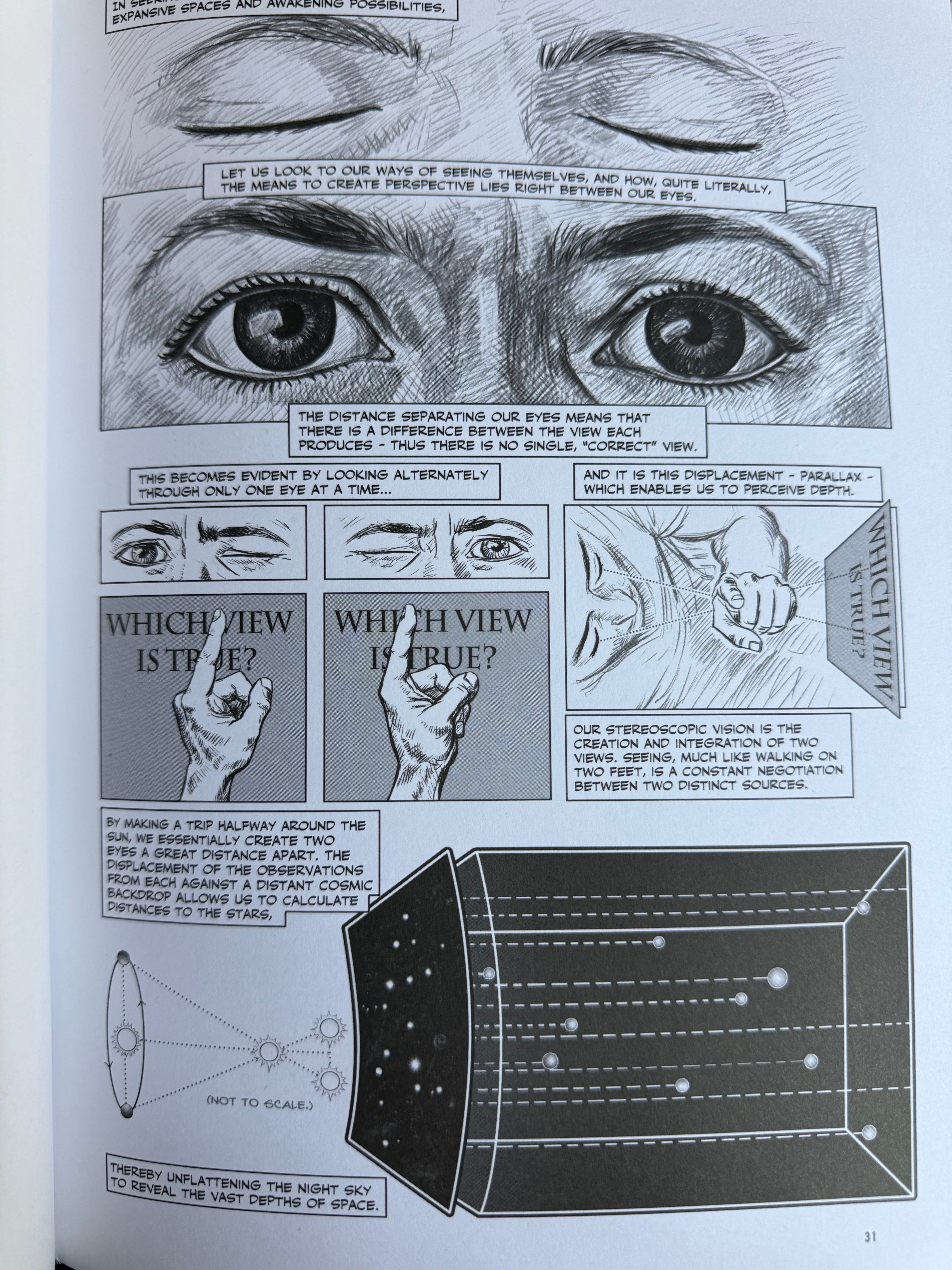
The image from Sousanis I keep coming back to is stereoscopic vision. If you’re able-bodied, the way you perceive the world is through the blending of two slightly different images coming from each one of your eyeballs. Stereoscopic vision is the creation and integration of two views. Walking on two feet, Sousanis writes, “is a constant negotiation between two distinct sources.” Seeing double is vital. The depth we experience comes from holding and interpreting two images simultaneously.
He extends this to the act of argument itself. “What if we reframed argument as a dance?” he asks. What if dueling parties became collaborative partners? It sounds a bit idealistic to me. The word I keep seeing in comment sections is nuance. People asking for nuance. People pointing out that the line between identities isn’t as clean as we think. They are asking, in their own way, for stereoscopic vision. For two images held at once instead of one image canceling the other.
Definition by negation is monocular, the opposite of stereoscopic vision. Negation picks one eye and closes the other. It gets you an image, but it’s a flat one. Stereoscopic vision, or nuance, is an alternative. We’re not pretending the two views are the same, but letting them coexist in a way that produces depth. Accept incompleteness, and you will discover more. The more you know, the less you know.
On Taste
The French sociologist Pierre Bourdieu4 argued that taste is never neutral. Every preference, every distinction, every positioning move (like negation) is within a field of competition. The people most invested in distinctions are usually the ones whose status is under the most contest. The ones who don’t possess a desired status have to work to position themselves with taste (through what they consume, wear, eat). What Bourdieu didn’t see coming was the field expanding to include everyone, by way of social media. He was mostly writing about French class hierarchy.
Influencers are getting front-row seats at runway shows. Content creators are getting network television deals. Coders and developers are being replaced by AI. Professions that used to be gatekept by credentials, access, and inherited wealth, are increasingly accessible to almost anyone. When the structural gates fall, the only way left to defend the hierarchy is to position through taste. “Influencers are tacky, content creators aren’t real journalists, the AI-assisted developer isn’t a real engineer…”
The creator economy has taken Bourdieu’s framework of leveraging taste to create distinction and run rampant. The field is now global. The performance of taste is constant. Your competition is visible at all times.
I’m writing this because we’re all watching it happen in real time. The flattening is accelerating, not slowing down. Every category bleeding into the one next to it. The recipe developer is a content creator; the gardener is also, depending on the day, accused of being a performative tradwife. I’m not above it. I do it too. I have questions that might open the door to a dance. If everything is adjacent to everything else, what do we do with it? Do we keep drawing lines, louder, sharper, in a futile attempt (the categories are going to collapse anyway)? My mind keeps returning to the “both” underscoring Slagle’s carousel. I think about stereoscopic vision and how two images, integrated, neither one canceling each other. Perhaps it’s as simple as practicing definition by description more. An apple is sweet, crisp, red and/or green.
Hmm…
Brewer, Marilynn B. 1991. "The Social Self: On Being the Same and Different at the Same Time." Personality and Social Psychology Bulletin 17 (5): 475–482.
White, Judith B., Michael T. Schmitt, and Ellen J. Langer. 2006. “Horizontal Hostility: Multiple Minority Groups and Differentiation from the Mainstream.” Group Processes & Intergroup Relations 9 (3): 339–358.
Sousanis, Nick. 2015. Unflattening. Cambridge, MA: Harvard University Press.
Bourdieu, Pierre. 1984. Distinction: A Social Critique of the Judgement of Taste. Translated by Richard Nice. Cambridge, MA: Harvard University Press.
Hell YES. This is so cool. Thank you Carmen for opening, tweezing, questioning, caring.
This was such a good read. Thank you!